
When homeowners think about battery backup, they usually start with one simple question:
“How long will my battery last?”
The better question is:
“What am I asking my battery to power?”
Because not all appliances are created equal. Some use a small amount of energy and can run for hours without much impact. Others can drain stored power quickly, especially if they run for long periods or require a large surge of electricity to start.
That does not mean you cannot back up larger appliances. It means you should understand which loads use the most energy, which ones matter most during an outage, and how to design your backup plan around real life.
Here is a practical ranking of the appliances and systems most likely to drain your home battery first.
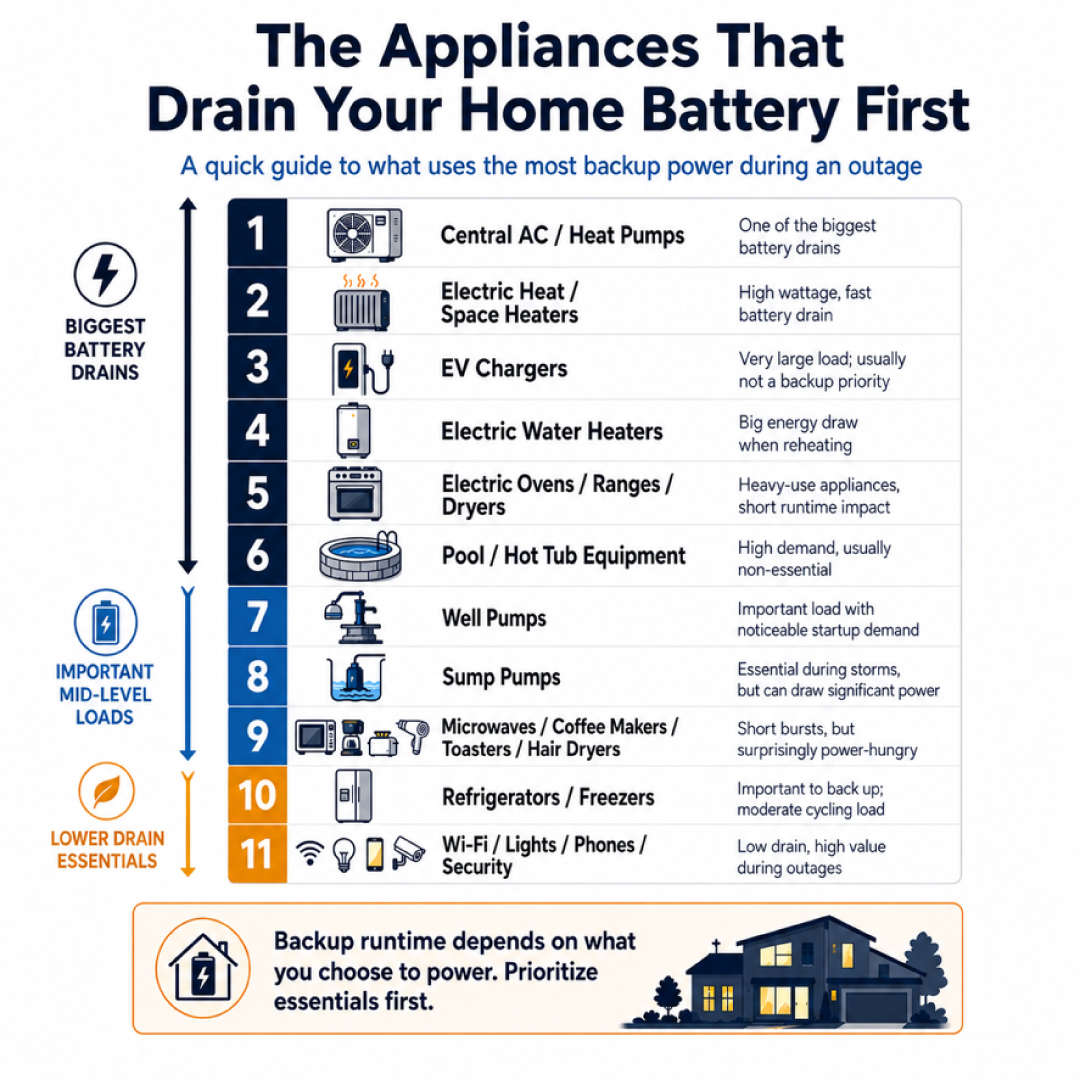
1. Central Air Conditioning and Heat Pumps
Central air conditioning is often one of the biggest battery drains in the home. It consumes a significant amount of power while running and may require an additional surge when the compressor starts.
In hot climates, this becomes even more important because air conditioning may run frequently during the same conditions that cause outages: heat waves, storms, wildfire shutoffs, or grid stress.
Heat pumps can also draw substantial power, especially when outdoor temperatures are extreme or auxiliary electric heat activates.
Backup planning tip: If cooling or heating is essential, ask your installer whether your system should support whole-home backup, partial-home backup, or selected HVAC operation. In some cases, homeowners may choose to power a single zone, use a more efficient mini-split, or limit HVAC use during longer outages.
2. Electric Resistance Heating and Space Heaters
Electric heating can drain a battery very quickly. This includes electric furnaces, baseboard heating, portable space heaters, and auxiliary heating elements in some systems.
Space heaters may look small, but they are often high-wattage devices. Running one continuously during an outage can drain stored energy much faster than lights, Wi-Fi, or a refrigerator.
Backup planning tip: If you use electric heat, determine whether it is a must-have load during an outage or whether you can rely on targeted heating, better insulation, warm clothing, or a smaller backup zone.
3. EV Chargers
An electric vehicle charger can consume a lot of energy, especially a Level 2 charger. Charging an EV from a home battery during an outage may be possible in some system designs, but it is usually not the best use of stored energy unless transportation is the top priority.
During a grid outage, the battery in your garage and the battery in your home energy system serve very different roles. Your home battery keeps essential household systems running.
Backup planning tip: If you want EV charging during outages, discuss it with your installer upfront. Otherwise, it may make more sense to charge the vehicle before expected storms or shutoffs and reserve home battery power for essentials.
4. Electric Water Heaters
Hot water feels like a basic necessity, but electric water heating can use a lot of energy. A traditional electric water heater may draw a large amount of power when heating a full tank.
The challenge is that water heating is easy to overlook until the outage lasts long enough for the hot water to run out.
Backup planning tip: During an outage, conserve hot water. Avoid laundry, long showers, and unnecessary dishwashing. If hot water is a priority, ensure your system is designed to handle that load.
5. Electric Ovens, Ranges, and Dryers
Electric ovens, cooktops, and clothes dryers are high-load appliances. They may not run all day, but when they are on, they can consume a lot of power.
During an outage, using an electric oven to cook dinner or running a dryer can significantly shorten battery life. These appliances are convenient, but they are rarely the best use of stored energy when the grid is down.
Backup planning tip: Consider outage-friendly alternatives for cooking and laundry. A microwave, small induction burner, toaster oven, or pre-planned meals may use less energy than a full-size electric oven. Laundry can usually wait.
6. Pool Pumps, Hot Tubs, and Spa Equipment
Pool pumps, hot tubs, and spa heaters can use surprisingly large amounts of energy. They may run for extended periods and, in the case of heating equipment, consume substantial power.
These systems are often not essential during an outage, but they can quietly drain a battery if they remain connected to backup circuits.
Backup planning tip: Unless there is a specific reason to keep them running, pool and spa loads are usually good candidates to shut off during an outage.
7. Well Pumps
A well pump may not run constantly, but it can draw a noticeable amount of power when it turns on. For homes that rely on a private well, the pump is not just an appliance. It is the source of household water.
That makes the well pump different from many other high-draw loads. It may use more power than small essentials, but it may also be one of the most important systems to back up.
Backup planning tip: If you have a well, inform your installer early in the design process. The pump’s starting requirements matter, and the system should be properly configured if water access is a priority.
8. Sump Pumps
Like well pumps, sump pumps usually run intermittently, but when you need them, you really need them.
During a storm, a sump pump may protect your basement or crawl space from flooding. While it can draw more power than small electronics, it may be one of the most valuable loads to keep online.
Backup planning tip: Consider a sump pump an essential load in homes where flooding is a risk. A battery backup can help maintain protection when storms cause both rain and outages.
9. Microwaves, Coffee Makers, Toasters, and Hair Dryers
Small appliances are not always low-energy users.
Microwaves, coffee makers, toasters, electric kettles, and hair dryers can draw a lot of power for short periods. They may not drain a battery as quickly as central air conditioning, but frequent use during an outage can still add up.
Backup planning tip: Use these appliances selectively. Short bursts are usually easier to manage than continuous operation, but each high-wattage device reduces runtime.
10. Refrigerators and Freezers
Refrigerators and freezers are usually high on the priority list, but they are not always the biggest battery drains. They cycle on and off throughout the day rather than running constantly.
That makes them strong candidates for backup power. They protect food, frozen meals, baby formula, and refrigerated medications without necessarily consuming as much energy as larger heating, cooling, or cooking loads.
Backup planning tip: Keep refrigerator and freezer doors closed during an outage. The less they have to run, the less energy they use.
11. Wi-Fi, Lights, Phones, Security, and Small Electronics
These are the low-drain heroes during an outage.
Wi-Fi routers, LED lights, phone chargers, laptops, security systems, smart hubs, and medical device chargers often use far less power than large appliances. Yet they can make a significant difference in comfort, safety, and communication.
During an outage, these loads help you stay connected, informed, and operational.
Backup planning tip: These should usually be part of an essential-load backup plan. They provide real value at a relatively small energy cost.
The Biggest Lesson: Runtime Is About Choices
A home battery is not just a tank of electricity. It is a tool for deciding what matters most when the grid goes down.
If you run central air, charge an EV, heat water, cook with an electric oven, and use a dryer during an outage, you’ll deplete your stored energy much faster. If you prioritize essentials such as refrigeration, Wi-Fi, lighting, medical devices, a well pump, a sump pump, and selected comfort loads, your battery can last longer.
The best backup plans are not one-size-fits-all. They are designed around the home, the climate, the family, and the systems that truly need to keep running.
Why Duracell Power Center MAX HYBRID Fits the Moment – Don’t let your favorite appliances drain your home battery
Duracell Power Center MAX HYBRID helps homeowners take control of backup power, solar energy, and everyday energy use. With solar integration, modular battery storage, smart controls, and reliable backup, it can support the systems that matter most when the grid is unavailable.
For one homeowner, that may mean keeping the refrigerator, Wi-Fi, lights, and security system running. For another, it may mean supporting larger loads, such as a well pump, sump pump, or selected heating and cooling equipment.
The key is planning before the outage occurs.
The appliance that drains your battery the fastest may not be the one you care about most.
Ready to design backup power that fits how your home actually works? Talk to Duracell Power Center about a solar-plus-storage system built for real life.